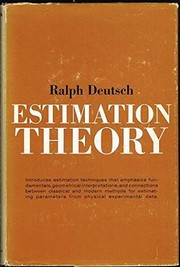
Estimation theory
R. Deutsch · 1965
Where to buy
Check today’s price on Amazon. We do not show prices because they change daily.
View on AmazonAffiliate link. As an Amazon Associate we earn from qualifying purchases.
About the book
Estimation theory ie an important discipline of great practical importance in many areas, as is well known. Recent developments in the information sciences—for example, statistical communication theory and control theory—along with the availability of large-scale computing facilities, have provided added stimulus to the development of estimation methods and techniques and have naturally given the theory a status well beyond that of a mere topic in statistics. The present book is a timely reminder of this fact, as a perusal of the table of conk). (covering thirteen chapters) indicates: Chapter I provides a concise historical account of the growth of the theory; Chapters 2 and 3 introduce the notions of estimates, estimators, and optimality, while Chapters 4 and 5 are devoted to Gauss' method of least squares and associated linear estimates and estimators. Chapter 6 approaches the problem of nonlinear estimates (which in statistical communication theory are the rule rather than the exception); Chapters 7 and 8 provide additional mathematical techniques ()marks; inverses, pseudo inverses, iterative solutions, sequential and re-cursive estimation). In Chapter I) the concepts of moment and maximum likelihood estimators are introduced, along with more of their associated (asymptotic) properties, and in Chapter 10 the important practical topic Of estimation erase 0 treated, their sources, confidence regions, numerical errors and error sensitivities. Chapter 11 is a sizable one, devoted to a careful, quasi-introductory exposition of the central topic of linear least-mean-square (LLMS) smoothing and prediction, with emphasis on the Wiener-Kolmogoroff theory. Chapter 12 is complementary to Chapter 11, and considers various methods of obtaining the explicit optimum processing for prediction and smoothing, e.g. the Kalman-Bury method, discrete time difference equations, and Bayes estimation (brieflY)• Chapter 13 complete. the book, and is devoted to an introductory expos6 of decision theory as it is specifically applied to the central problems of signal detection and extraction in statistical communication theory. Here, of course, the emphasis is on the Payee theory Ill. The book ie clearly written, at a deliberately heuristic though not always elementary level. It is well-organised, and as far as this reviewer was able to observe, very free of misprints. However, the reviewer feels that certain topics are handled in an unnecessarily restricted way: the treatment of m
Book details
- Year
- 1965
- Language
- English
- Publisher
- Prentice-Hall
- Editions
- 1
- Pages
- 288
- ISBN
- 9781124017068
Data source: Wikidata