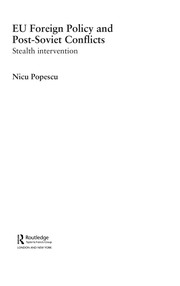
EU foreign policy and post-Soviet conflicts
Nicu Popescu · 2011
Where to buy
Amazon’s price changes daily, so the most accurate place to see it is there, at the moment you buy.
View on AmazonThis is an affiliate link: if you buy through it, the site earns a small commission at no extra cost to you, which helps us bring quality content and maintain the site. As an Amazon Associate we earn from qualifying purchases.
About the book
The European Union is still emerging as a fully fledged foreign policy actor. The vagaries of this process are clearly visible, yet insufficiently explained in the EU policies towards the post-Soviet space. EU Foreign Policy and Post-Soviet Conflicts examines EU intervention and non-intervention in conflict resolution, with a specific focus on the EU's role in the post-soviet conflicts in the South Caucasus and Moldova: Abkhazia, South Ossetia, Nagorno-Karabakh and Transnistria. It explains how EU foreign policy affected these conflicts, but more importantly what EU intervention in these conflicts reveal about the EU itself. Based on extensive field research, the author argues that the reluctant EU intervention in post-Soviet conflicts results from a dichotomous relationship between EU institutions and some EU member states. Popescu argues this demonstrates that EU institutions use policies of 'stealth intervention' where they seek to play a greater role in the post-Soviet space, but they do so through relatively low-profile, uncontroversial and depoliticized actions in order to avoid visible Russian opposition. Exploring an array of questions related to the EU as a foreign policy actor, this book traces the politics of conflict intervention by EU institutions using original empirical data related to the EU decision making process.
Book details
- Year
- 2011
- Language
- English
- Series
- Routledge advances in European politics -- 71
- Publisher
- Routledge
- Editions
- 9
- Pages
- 157
- ISBN
- 9780415587204
Data source: Wikidata