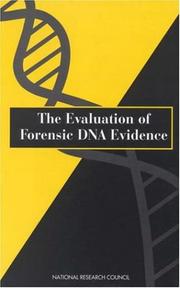
Evaluation of Forensic DNA Evidence
Where to buy
Amazon’s price changes daily, so the most accurate place to see it is there, at the moment you buy.
View on AmazonAbout the book
In 1992 the National Research Council issued DNA Technology in Forensic Science, which documented the state of the art in this emerging field. The Evaluation of Forensic DNA Evidence reports on how this evidence is interpreted in the courts, includes developments in population genetics and statistics since the original book, and comments on statements in the original volume that proved controversial or that have been misapplied in the courts. This book offers recommendations for handling DNA samples, for performing calculations, and on other aspects of using DNA as a forensic tool - modifying some of the previous recommendations. It addresses determination of DNA profiles and considers how laboratory errors (particularly false matches) can arise, how errors might be reduced, and how to take into account the fact that the error rate can never be reduced to zero. Also discussed is the interpretation of a finding that the DNA profile of a suspect or victim matches the evidence DNA. The Evaluation of Forensic DNA Evidence also addresses controversies in population genetics, exploring the problems that arise from the mixture of groups and subgroups in the American population and how this can be accounted for in calculating frequencies. It examines statistical issues in interpreting frequencies as probabilities, including adjustments when a suspect is found through a database search. The book includes a detailed discussion of what its recommendations would mean in the courtroom, accompanied by numerous case citations.
Book details
- Year
- 1996
- Language
- English
- Publisher
- National Academy Press
- Editions
- 1
- Pages
- 254
- ISBN
- 9780309053952
Data source: Wikidata
More by National Research Council (US)