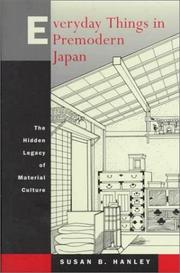
Everyday things in premodern Japan
Susan B. Hanley · 1997
Where to buy
Amazon’s price changes daily, so the most accurate place to see it is there, at the moment you buy.
View on AmazonAbout the book
Japan was the only non-Western nation to industrialize before 1900. Its leap into the modern era has stimulated vigorous debates among historians and social scientists. Were the Japanese people somehow better prepared for industrialization than people of other countries? In this book, Susan B. Hanley looks to life in Japan before industrialization for answers. Hanley focuses on the level of physical well-being of ordinary Japanese people in the three centuries prior to the modern era (the Tokugawa period, 1600-1868). Whereas others have used income levels to conclude that the Japanese household was relatively poor in those centuries, Hanley examines consumption patterns - of food, clothing, and housing - and discovers that the overall level of well-being there was much higher than previously understood. Analysis of hygiene and public sanitation shows Japan to have been at least as healthful as nineteenth-century England, nearly a century after industrialization began there. Perhaps even more far-reaching than Hanley's conclusions about Japan in the nineteenth century are her insights into the importance of physical well-being as a key indicator of living standards in premodern cultures. Using Hanley's methods, scholars in all areas of history will be able to compare widely differing cultures more meaningfully. Her discoveries and her new approach will be useful to anyone interested in the effects of modernization on daily life.
First sentence: How well did the Japanese live prior to their industrialized in the late nineteenth century?
Book details
- Year
- 1997
- Language
- English
- Publisher
- University of California Press
- Editions
- 1
- Pages
- 227
- ISBN
- 9780520218123
Data source: Wikidata