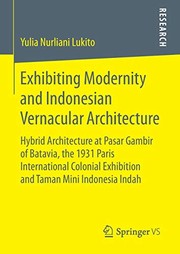
Exhibiting Modernity and Indonesian Vernacular Architecture
Yulia Nurliani Lukito · 2015
Where to buy
Amazon’s price changes daily, so the most accurate place to see it is there, at the moment you buy.
View on AmazonAbout the book
In her research Yulia Nurliani Lukito analyses modernity and the construction of culture by the authorities using the images of Indonesian vernacular architecture presented at three different sites and times. She argues that modernity is not solely constructed by the authorities, rather it is an ongoing process modified by visitors of exhibitions. Pasar Gambir was a laboratory of modernity for the colony, and an important stage in modernizing and negotiating cultural and social conditions in the colony. The Dutch Pavilion at the 1931 colonial exhibition became a moment when the Indies heritages played a role in marking colonial territory. Modern ethnographic park of Taman Mini gives a way to the making of an official 'authentic' culture and suppresses the previous Dutch construction of the Indies culture. Contents · Pasar Gambir of Batavia: Hybrid Architecture and Space of Encounter for the Indies People · The Dutch Pavilion at the 1931 International Colonial Exhibition in Paris: Contrasting Authenticity and Modernity · Taman Mini Indonesia Indah: the Rebirth of Indonesian Vernacular Architecture after Independence Target Groups · Lecturers and students of the social sciences especially in history and theory of architecture · Readers who are interested in cultural studies, architecture, history, and modernity The Author Yulia Nurliani Lukito received her doctorate degree in Theory of Architecture from RWTH Aachen. Her research interests are theory and history of architecture, modernity, and Indonesian vernacular architecture.
Book details
- Year
- 2015
- Language
- English
- Publisher
- Springer VS
- Editions
- 3
- Pages
- 208
- ISBN
- 9783658116040
Data source: Wikidata