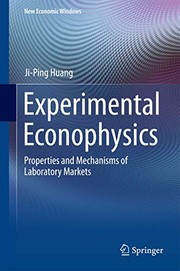
Experimental Econophysics
Ji-Ping Huang · 2016
Where to buy
Check today’s price on Amazon. We do not show prices because they change daily.
View on AmazonAffiliate link. As an Amazon Associate we earn from qualifying purchases.
About the book
Experimental Econophysics describes the method of controlled human experiments, which is developed by physicists to study some problems in economics or finance, namely, stylized facts, fluctuation phenomena, herd behavior, contrarian behavior, hedge behavior, cooperation, business cycles, partial information, risk management, and stock prediction. Experimental econophysics together with empirical econophysics are two branches of the field of econophysics. The latter one has been extensively discussed in the existing books, while the former one has been seldom touched. In this book, the author will focus on the branch of experimental econophysics. Empirical econophysics is based on the analysis of data in real markets by using some statistical tools borrowed from traditional statistical physics. Differently, inspired by the role of controlled experiments and system modelling (for computer simulations and/or analytical theory) in developing modern physics, experimental econophysics specially relies on controlled human experiments in the laboratory (producing data for analysis) together with agent-based modelling (for computer simulations and/or analytical theory), with an aim at revealing the general cause-effect relationship between specific parameters and emergent properties of real economic/financial markets. This book covers the basic concepts, experimental methods, modelling approaches, and latest progress in the field of experimental econophysics.
Book details
- Year
- 2016
- Language
- English
- Publisher
- Springer Berlin / Heidelberg
- Editions
- 4
- Pages
- 192
- ISBN
- 9783662515211
Data source: Wikidata