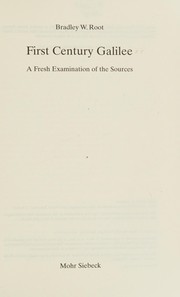
First century Galilee
Bradley W. Root · 2014
Where to buy
Amazon’s price changes daily, so the most accurate place to see it is there, at the moment you buy.
View on AmazonAbout the book
This dissertation argues against the widespread belief among current scholars that Galilee experienced extensive Hellenization, rapid urbanization, and a socio-economic crisis in the first-century C.E. as a result of major socio-economic changes initiated by Herod the Great and his successors. My research indicates that earlier studies allowed the textual evidence to have an undue influence on the way that scholars interpret the archaeological evidence, and vice-versa. Unlike previous studies on Early Roman Galilee, the dissertation begins by attempting to interpret each source for the region individually and without recourse to other sources. After establishing what each source says on its own about Galilee, the dissertation analyzes the data as a whole and offers a reconstruction of Galilean society in the first-century C.E. that better reflects the available evidence. The major findings are that the region was politically stable until the Great Revolt of 66 C.E., that the region was much less Hellenized than some prominent scholars claim, that the urbanization process initiated by Herod Antipas had less of a negative immediate impact on Galilean society than modern scholars usually assume, and that Galilee was not experiencing any unusual or severe socio-economic problems prior to the revolt.
Book details
- Year
- 2014
- Language
- English
- Series
- Wissenschaftliche Untersuchungen zum Neuen Testament. 2. Reihe -- 378
- Publisher
- Mohr Siebeck
- Editions
- 1
- Pages
- 228
- ISBN
- 9783161534898
Data source: Wikidata