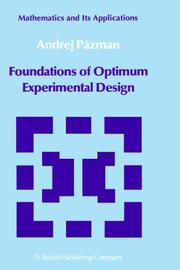
Foundations of Optimum Experimental Design
Andrej Pázman · 1986
Where to buy
Amazon’s price changes daily, so the most accurate place to see it is there, at the moment you buy.
View on AmazonAbout the book
This book contains an exposition of the theory and methods of optimum experimental design. It is aimed at giving an exact and systematic mathemati-cal presentation of a topic which is sufficiently evolved to be considered a self-contained part of mathematical statistics. The book will be useful as an introductory text for researchers in the field, as a textbook for students of statistics, and as a theoretical background for users of optimum design in experimental research: physics, chemistry, geodesy, building and electrical engineering, etc. After presenting the linear estimation theory necessary for understanding experimental design, the book moves on to a discussion of the uniform ordering of designs, admissable designs, and properties of the variances of estimates. Discontinuities which can appear with singular designs are ana-lysed here and in other parts of the book. Properties of optimality criteria are then presented, in particular the important consequences of convexity, e.g. the equivalence theorem, are discussed in detail. Methods of computations of optimum designs precede a chapter on generalization of the theory to in-finite-dimensional models.
Book details
- Year
- 1986
- Language
- English
- Series
- Mathematics and its applications; East European series
- Publisher
- Springer Netherlands, Kluwer Academic Publishers
- Editions
- 1
- Pages
- 250
- ISBN
- 9789027718655
Data source: Wikidata