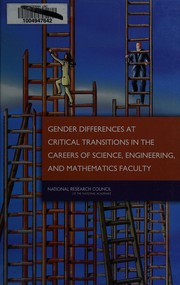
Gender differences at critical transitions in the careers of science, engineering, and mathematics faculty
National Research Council, Division of Behavioral and Social Sciences and Education Staff · 2009
Where to buy
Amazon’s price changes daily, so the most accurate place to see it is there, at the moment you buy.
View on AmazonAbout the book
"Gender Differences at Critical Transitions in the Careers of Science, Engineering, and Mathematics Faculty presents new and surprising findings about career differences between female and male full-time, tenure-track, and tenured faculty in science, engineering, and mathematics at the nation's top research universities. Much of this congressionally mandated book is based on two unique surveys of faculty and departments at major U.S. research universities in six fields: biology, chemistry, civil engineering, electrical engineering, mathematics, and physics. A departmental survey collected information on departmental policies, recent tenure and promotion cases, and recent hires in almost 500 departments. A faculty survey gathered information from a stratified, random sample of about 1,800 faculty on demographic characteristics, employment experiences, the allocation of institutional resources such as laboratory space, professional activities, and scholarly productivity. This book paints a timely picture of the status of female faculty at top universities, clarifies whether male and female faculty have similar opportunities to advance and succeed in academia, challenges some commonly held views, and poses several questions still in need of answers. This book will be of special interest to university administrators and faculty, graduate students, policy makers, professional and academic societies, federal funding agencies, and others concerned with the vitality of the U.S. research base and economy."--Publisher's description.
Book details
- Year
- 2009
- Language
- English
- Publisher
- National Academies Press
- Editions
- 1
- Pages
- 365
- ISBN
- 9780309114639
Data source: Wikidata
More by National Research Council