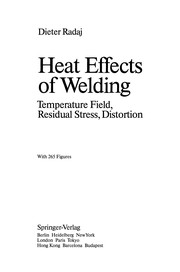
Heat Effects of Welding
Dieter Radaj · 1992
Where to buy
Amazon’s price changes daily, so the most accurate place to see it is there, at the moment you buy.
View on AmazonAbout the book
Welding is the most important method of joining components made of metallic materials. Most welding processes involve the melting of the surfaces to be joined followed by subsequent cooling. Melting is achieved by local heat input, keeping heat diffusion into the component and heat dissipation into the surroundings as low as possible. The effects of local heating are summarized under the term "weldability", a property of the structure to be welded influenced by design, material and manufacturing measures. In recent years, theoretical developments in thermodynamics, continuum mechanics and microstructural kinetics have made a systematic assessment of weldability possible. This includes the weldability-related optimization of design, materials and welding processes. The systematic approach based on theory and mathematics is termed "weldability analysis". This book isbased on this systematic approach. It proceeds from the temperature field, treats residual stress and distortion on that basis and ends with practitioners' measures to reduce the former. A preliminary chapter introduces the field and a final chapter reviews the strength effects of welding.
Book details
- Year
- 1992
- Language
- English
- Publisher
- Springer Berlin Heidelberg
- Editions
- 4
- Pages
- 348
- ISBN
- 9783642486425
Data source: Wikidata
More by Dieter Radaj