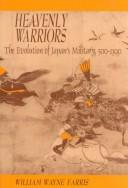
Heavenly warriors
William Wayne Farris · 1992
Where to buy
Amazon’s price changes daily, so the most accurate place to see it is there, at the moment you buy.
View on AmazonThis is an affiliate link: if you buy through it, the site earns a small commission at no extra cost to you, which helps us bring quality content and maintain the site. As an Amazon Associate we earn from qualifying purchases.
About the book
"The word samurai suggests the colorful figure of a lightly armored, mounted archer attended by two or three foot soldiers engaging in ritualized one-on-one combat, the aristocratic fighting man of the Kamakura Shogunate (1185-1333). Although some historians have considered the rise of the samurai as analogous to the rather abrupt rise of feudal knights in medieval Western Europe, Farris provides an "evolutionary model" for Japan that traces the step-by-step adaptive development of local strongmen over more than half a millennium. Through analyses of military technology and tactics, social organization, economic base, and political skills, mainly based on Japanese primary sources, Farris demonstrates some of the underlying continuities in that development together with the rather late acquisition by warriors of those political capabilities that led to the dominance of the Shogunate over the Court." "Japan's original Heavenly Warrior, the Emperor Temmu, declared in 684, "In a government, military matters are the essential thing." Farris's detailed descriptions and maps of major battles from the Korean Wars of the sixth century through the thirteenth-century Mongol Invasions underscore the validity of that judgment. Finally, Minamoto no Yoritomo triumphed as "the chief of all warriors," and established his Shogunate in 1185, giving a firmer political base to Japan's warrior elite."--Jacket.
Book details
- Year
- 1992
- Language
- English
- Publisher
- Harvard University Asia Center
- Editions
- 2
- Pages
- 400
- ISBN
- 9780674387041
Data source: Wikidata
More by William Wayne Farris