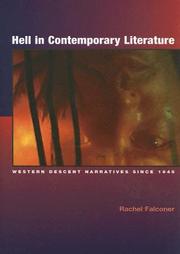
Hell in Contemporary Literature
Rachel Falconer · 2005
Where to buy
Amazon’s price changes daily, so the most accurate place to see it is there, at the moment you buy.
View on AmazonAbout the book
What does it mean when people use the word Hell to convey the horror of an actual, personal or historical experience? This book explores the idea that modern, Western secular cultures have retained a belief in the concept of Hell as an event or experience of endless or unjust suffering. In the contemporary period, the descent to Hell has come to represent the means of recovering - or discovering - selfhood. These ideas have combined with earlier literary and religious models of katabatic narrative to produce the notion of a self made ethical by its encounter with the underworld. In exploring these ideas, this book discusses descent journeys in Holocaust testimony and fiction, memoirs of mental illness, and feminist, postmodern and postcolonial narratives written after 1945. A wide range of texts are discussed, including writing by Primo Levi, W.G. Sebald, Anne Michaels, Alasdair Gray, and Salman Rushdie, and films such as Coppola's Apocalypse Now and the Matrix trilogy. Drawing on theoretical writing by Bakhtin, Levinas, Derrida, Judith Butler, David Harvey and Paul Ricoeur, the book addresses such broader theoretical issues as: narration and identity; the ethics of the subject; trauma and memory; descent as sexual or political dissent; the interrelation of realism and fantasy; and Occidentalism and Orientalism. Book jacket.
Book details
- Year
- 2005
- Language
- English
- Publisher
- Edinburgh University Press
- Editions
- 4
- Pages
- 256
- ISBN
- 9780748617630
Data source: Wikidata
More by Rachel Falconer