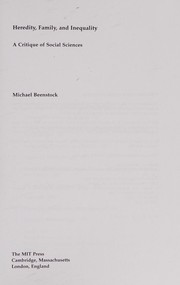
Heredity, family, and inequality
Michael Beenstock · 2012
Where to buy
Amazon’s price changes daily, so the most accurate place to see it is there, at the moment you buy.
View on AmazonAbout the book
Empirical literature in disciplines ranging from behavioral genetics to economics shows that in virtually every aspect of life the outcomes of children are correlated to a greater or lesser extent with the outcomes of their parents and their siblings. In Heredity, Family, and Inequality, the economist Michael Beenstock offers theoretical, statistical, and methodological tools for understanding these correlations. Beenstock presents a comprehensive survey of intergenerational and sibling correlations for a broad range of outcomes--including fertility and longevity, intelligence and education, income and consumption, and deviancy and religiosity. He then offers a critique of the sometimes conflicting explanations for these correlations proposed by social scientists from such disciplines as developmental psychology, sociology, and economics. Beenstock also provides an axiomatic framework for thinking about the complex interplay of heredity, family, and environments, drawing on game theory, control theory, and econometrics. Chapters 1-7 discuss such topics as the important contributions of Francis Galton (1822--1911) to the statistical study of heredity, the family as an engine of inequality and diversity, and natural experiments designed to identify how environments, families, peer groups, and neighborhoods affect human outcomes. Chapters 8-10 present technical material on statistical, theoretical, and methodological tools used by the earlier chapters. Beenstock's goal is not to argue for either nature or nurture but to suggest more rigorous ways to assess the diverse contributions to this lively debate.
Book details
- Year
- 2012
- Language
- English
- Publisher
- MIT Press
- Editions
- 1
- Pages
- 474
- ISBN
- 9780262016926
Data source: Wikidata