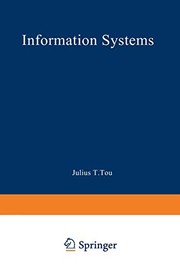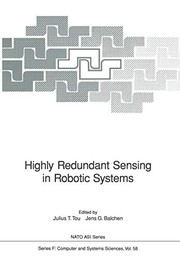
Highly Redundant Sensing in Robotic Systems
Julius T. Tou · 1990
Where to buy
Amazon’s price changes daily, so the most accurate place to see it is there, at the moment you buy.
View on AmazonAbout the book
Design of intelligent robots is one of the most important endeavors in robotics research today. The key to intelligent robot design lies in sensory systems for robotic control and manipulation. In an unstructural environment, robotic sensing translates measurements and characteristics of the environment and working objects into useful information. A robotic system is usually equipped with a variety of sensors to perform redundant sensing and achieve data fusion. This book contains revised versions of papers presented at a NATO Advanced Research Workshop held in Florida in September 1989 within the activities of the NATO Special Programme on Sensory Systems for Robotic Control. The fundamental issues addressed in this volume were: - Theory and techniques, including knowledge-based systems, geometrical fusion, Boolean fusion, probabilistic fusion, feature-based fusion, error-estimation approach, and Markov process modeling. - General concepts, including microscopic redundancy at the sensory element level, macroscopic redundancy at the sensory system level, parallel redundancy, and standby redundancy. - Implementation and application, including robotic control, sensory technology, robotic assembly, robot fingers, sensory signal processing, sensory system integration, and PAPIA architecture. - Biological analogies, including neural nets, pattern recognition, low-level fusion, and motor learning.
Book details
- Year
- 1990
- Language
- English
- Series
- NATO ASI Series, Series F: Computer and Systems Sciences -- 58
- Publisher
- Springer Berlin Heidelberg
- Editions
- 3
- Pages
- 322
- ISBN
- 9783642840517
Data source: Wikidata
More by Julius T. Tou