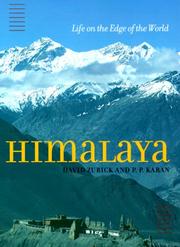
Himalaya
David Zurick, P. P. Karan · 1999
Where to buy
Check today’s price on Amazon. We do not show prices because they change daily.
View on AmazonAffiliate link. As an Amazon Associate we earn from qualifying purchases.
About the book
The majestic natural beauty of the Himalaya Mountains has inspired awe and religious devotion in people around the world for millennia. With thirty peaks rising over 25,000 feet (7,620 meters) -- including Everest and Kanchenzonga, the world's highest and third-highest peaks -- the Himalaya dwarf all other mountain ranges. Sprawling 2,700 kilometers across India, Pakistan, Nepal, Tibet, and Bhutan, the Himalaya possess an abundance of ecological niches, from subtropical to arctic climates, and support vast quantities of flora and fauna -- more than 650 varieties of orchids thrive in the wet mountain region of Sikkim alone. In the valleys, a surprising number of tenacious peoples have over centuries carved out diverse cultures in the harsh mountain environment. Although seemingly timeless, the Himalaya are anything but unchanging. The mountains themselves continue to grow an average of one centimeter per year, with some peaks rising ten centimeters in a single year. More alarming are the profound environmental and cultural changes occurring throughout the region. In Himalaya: Life on the Edge of the World, David Zurick and P. P. Karan explore these dynamic changes through geological records, scientific reports, and official documents dating back over a century and through years of field research and travel which have given them an intimate knowledge of the landscape and people of the Himalaya. The authors provide a comprehensive natural history of the region from the birth of the Himalaya out of the tectonic disruptions beneath the primordial Tethys Sea to the variety of landforms, habitats, and climates seen today; a lively study of the peoples who make the mountains their home, tracing human history in the Himalaya back more than a thousand years; and an in-depth analysis of the relationship between nature and society in the Himalaya and the pressing problems of environmental degradation, explosive population growth, spiraling poverty, and globalization confronting the region and its people. Challenging widely held assumptions about the current ecological crisis in the Himalaya -- that deforestation, for example, can be blamed exclusively on local villagers or that pollution and rampant resource exploitation occur uniformly throughout the range -- the authors detail a much more complex scenario in which the population explosion is only one of the many factors affecting the Himalayan landscape and in which some regions exhibit little of the environmental d
Book details
- Year
- 1999
- Language
- English
- Publisher
- The Johns Hopkins University Press
- Editions
- 1
- Pages
- 376
- ISBN
- 9780801861680
Data source: Wikidata
More by David Zurick