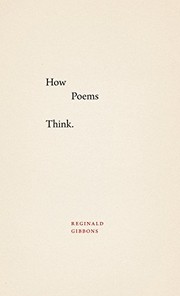
How Poems Think
Reginald Gibbons · 2015
Where to buy
Amazon’s price changes daily, so the most accurate place to see it is there, at the moment you buy.
View on AmazonThis is an affiliate link: if you buy through it, the site earns a small commission at no extra cost to you, which helps us bring quality content and maintain the site. As an Amazon Associate we earn from qualifying purchases.
About the book
Reginald Gibbons collects here a lifetime's worth of thoughts on composing and translating poetry. Not a manifesto or a general theory of the lyric, rather, the book explores how a poem thinks: that is, what results from the circumstances of a poet's native language, choice of words and topics, the mentality that the poet shares with other writers, and the range of poetic possibilities (and limitations) in a given language. Through exemplary case studies taken from his own experience in writing poetry, as well as in translating poetry from languages ranging from Sophocles's and Pindar's ancient Greek to their contemporary French, Italian, Portuguese, Russian, and Spanish successors, Gibbons traces the curious persistence of classical modes and images into the twenty-first century. He shows how the very language used in composing a poem, be it ancient Greek, Renaissance English, or contemporary Russian, both limits and enables how a poet thinks and what the poet can say. Even in describing difficult poetic concepts and operations, Gibbons writes in a clear, companionable style, entirely accessible not just to practicing poets, but also to general readers interested in poetry, and to writers of various stripes interested in the way our native language can often circumscribe what and how we think poetically, and affect how we compose poetry and prose. This book joins other titles by this award-winning writer on the Press's list.
Book details
- Year
- 2015
- Language
- English
- Publisher
- University of Chicago Press
- Editions
- 4
- Pages
- 208
- ISBN
- 9780226277950
Data source: Wikidata
More by Reginald Gibbons