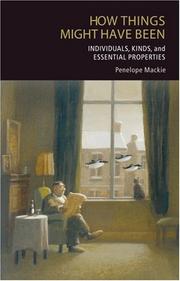
How Things Might Have Been
Penelope Mackie · 2006
Where to buy
Amazon’s price changes daily, so the most accurate place to see it is there, at the moment you buy.
View on AmazonThis is an affiliate link: if you buy through it, the site earns a small commission at no extra cost to you, which helps us bring quality content and maintain the site. As an Amazon Associate we earn from qualifying purchases.
About the book
"How are we to distinguish between the essential and accidental properties of things such as individual people, cats, trees, and tables? Almost everyone agrees that such individuals could have been different, in certain respects, from the way that they actually are. But what are the respects in which they could not have been different: which of their properties are essential to their being the individuals that they are? And why?" "Following the revival of interest among analytic philosophers in essentialism and de re modality generated by the work of Kripke and others in the 1970s, these questions have been the subject of intense, yet still unresolved, debate. In this book, Penelope Mackie challenges most of the answers that have been given to these questions. Via a critical examination of rival theories, she arrives at what she calls 'minimalist essentialism', an unorthodox theory according to which ordinary individuals have relatively few interesting essential properties, and intuitions that appear to support stronger versions of essentialism are interpreted as consistent with the theory."--Jacket.
Book details
- Year
- 2006
- Language
- English
- Publisher
- Oxford University Press, USA
- Editions
- 5
- Pages
- 224
- ISBN
- 9780199272204
Data source: Wikidata