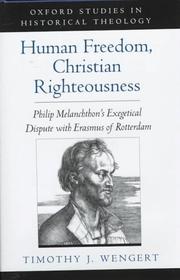
Human Freedom, Christian Righteousness
Timothy J. Wengert · 1997
Where to buy
Amazon’s price changes daily, so the most accurate place to see it is there, at the moment you buy.
View on AmazonAbout the book
"This book argues the provocative thesis that Philip Melanchthon, so often pictured as hopelessly caught in the middle between Erasmus and Luther, and more "Erasmian" than Lutheran in his thought, was, at least in his theological methods and views, not Erasmian at all, but in fact sharply opposed to Erasmus. Author Timothy J. Wengert builds his case largely on the basis of Melanchthon's Scholia on the Epistle of Paul to the Colossians, employing the critically important but seldom used second edition of 1528, which was produced in the aftermath of Luther and Erasmus's famous debate over the freedom of the will. Wengert also draws on a wide range of other contemporary sources, many of them well known but, as he argues, frequently misunderstood. Throughout this analysis he subjects a wide range of the secondary literature to sharp critical review.". "The book deals with a number of important topics: the complicated and elusive relationships between humanism and the Reformation, Erasmus and Luther, Erasmus and Melanchthon, and Melanchthon and Luther; the theological issues of proper biblical interpretation, of free will, and of divine and human righteousness; and the hotly contested social problem of political order. Human Freedom, Christian Righteousness will be of interest not only to students and scholars of Reformation theology, but to a broader audience of those concerned with Renaissance and Reformation history and literature."--BOOK JACKET.
Book details
- Year
- 1997
- Language
- English
- Publisher
- Oxford University Press, USA
- Editions
- 1
- Pages
- 254
- ISBN
- 9780195115291
Data source: Wikidata
More by Timothy J. Wengert