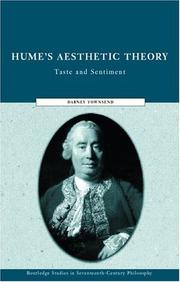
Hume's Aesthetic Theory
Dabney Townsend · 2001
Where to buy
Amazon’s price changes daily, so the most accurate place to see it is there, at the moment you buy.
View on AmazonAbout the book
"David Hume famously said that reason is and ought only to be the slave of the passions. Hume's Aesthetic Theory traces the roots of aesthetics in the concepts of 'sentiment' and 'taste' and the epistemological possibilities that Hume's use of them has offered." "Aesthetics has tended to concentrate on forms of aesthetic experience and attitude that developed after Kant's Third Critique, but these concepts contrast with aesthetic thought in the eighteenth century, which is based on 'sentiment' and 'taste'. Neglect of the earlier eighteenth-century concepts obscures the alternatives available to aesthetic theory and misreads the history of aesthetics. In this respect, Dabney Townsend argues that Hume's contribution to aesthetic thought has been insufficiently explored and that attention to it can shed light on the theoretical underpinning of Hume's philosophy as a whole. More importantly, it can deepen our understanding of the history of aesthetics and offer renewed possibilites for contemporary aesthetics." "Hume's Aesthetic Theory is a major contribution to our understanding of Hume's general philosophy and will provide fresh insights into the history of aesthetics. It will prove invaluable to all those interested in Hume and aesthetics."--Jacket.
First sentence: To understand properly the use of the concept of sentiment as it developed in the first half of the eighteenth century in relation to aesthetic issues, it must be differentiated from contemporary forms of relativism and subjectivism that are based on a separation of psychological and epistemological evidence.
Book details
- Year
- 2001
- Language
- English
- Publisher
- Routledge
- Editions
- 1
- Pages
- 272
- ISBN
- 9780415233965
Data source: Wikidata