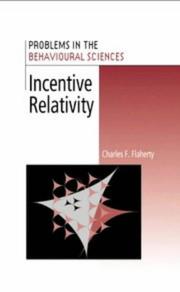
Incentive Relativity
Charles F. Flaherty · 1996
Where to buy
Check today’s price on Amazon. We do not show prices because they change daily.
View on AmazonAffiliate link. As an Amazon Associate we earn from qualifying purchases.
About the book
Incentive Relativity summarizes the early history of research on the effects of reward magnitude on animal behaviour, emphasizing those studies that led to recognition that rewards have relative, as well as absolute, effects. Recent research is presented in terms of three basic situations in which relativity or contrast effects occur: changing abruptly from an expected reward to a differently valued one (successive contrast); temporarily pairing two rewards of different value on a regular, daily basis (anticipatory contrast); and contrast that occurs during the course of discrimination learning (behavioural contrast, which is viewed as a combination of the two more elementary contrast types). Each relativity effect is analyzed in terms of procedures, parameters, psychopharmacology, psychobiology, and theory. Potential extensions to relativity in human behaviour are presented in the text, particularly in the prologue and the epilogue. An appendix summarizes the psychopharmacology of successive contrast and extinction using several animal models of anxiety. The book will appeal to behavioural neuroscientists and psychologists.
First sentence: The assumption that learning, at least trial and error learning, is based on the production of pleasure and elimination of displeasure was fundamental to the views of Herbert Spencer (1870), Alexander Bain (1855), and Thorndike (1911; see discussion in Boakes, 1984).
Book details
- Year
- 1996
- Language
- English
- Publisher
- Cambridge University Press
- Editions
- 1
- Pages
- 240
- ISBN
- 9780521658638
Data source: Wikidata