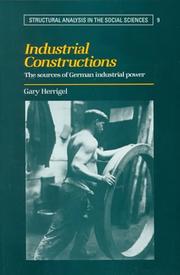
Industrial Constructions
Gary Herrigel · 1995
Where to buy
Check today’s price on Amazon. We do not show prices because they change daily.
View on AmazonAffiliate link. As an Amazon Associate we earn from qualifying purchases.
About the book
Germany's rise to industrial might has traditionally been attributed to the development of "organized" capitalism, which is said to encompass large, bureaucratic corporations, a unique system of universal banking, centralized peak associations, and an accommodating state. Gary Herrigel argues that this conceptualization of the sources of German industrial power is highly misleading because it ignores the achievement of a very robust alternative form of capitalism within the boundaries of the German political economy and overestimates the coherence of the national system of industrial governance. The upshot of Herrigel's argument is not only that there were several processes of industrialization that occurred simultaneously in German history, but that there has never been a single boundary between industry and the rest of society and politics in Germany; there have always been several. Theoretically, the book rejects the fundamentally unitary conceptions of industrialization and political economy underlying the Gerschenkronian, Schumpetarian, and Chandlerian principles that shape the traditional organized capitalism research program in the study of the German industrial economy and argues for a more open social constructivist approach.
First sentence: Most historical and contemporary accounts of the political economy of industry in Germany written since the end World War II depict a highly centralized, large-firm-dominated, ultimately neocorporatist industrial system whose characteristic institutional features all can be traced back to Germany's "late" industrialization.
Book details
- Year
- 1995
- Language
- English
- Publisher
- Cambridge University Press
- Editions
- 2
- Pages
- 492
- ISBN
- 9780521778596
Data source: Wikidata