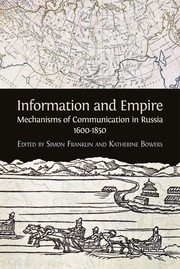
Information and Empire
Simon Franklin, Katherine Bowers, Open Book Publishers · 2017
Where to buy
Amazon’s price changes daily, so the most accurate place to see it is there, at the moment you buy.
View on AmazonThis is an affiliate link: if you buy through it, the site earns a small commission at no extra cost to you, which helps us bring quality content and maintain the site. As an Amazon Associate we earn from qualifying purchases.
About the book
"From the mid-sixteenth to the mid-nineteenth century Russia was transformed from a moderate-sized, land-locked principality into the largest empire on earth. How did systems of information and communication shape and reflect this extraordinary change? Information and Mechanisms of Communication in Russia, 1600-1850 brings together a range of contributions to shed some light on this complex question. Communication networks such as the postal service and the gathering and circulation of news are examined alongside the growth of a bureaucratic apparatus that informed the government about its country and its people. The inscription of space is considered from the point of view of mapping and the changing public ?graphosphere? of signs and monuments. More than a series of institutional histories, this book is concerned with the way Russia discovered itself, envisioned itself and represented itself to its people. Innovative and scholarly, this collection breaks new ground in its approach to communication and information as a field of study in Russia. More broadly, it is an accessible contribution to pre-modern information studies, taking as its basis a country whose history often serves to challenge habitual Western models of development. It is important reading not only for specialists in Russian Studies, but also for students and non-Russianists who are interested in the history of information and communications."
Book details
- Year
- 2017
- Language
- English
- Publisher
- Open Book Publishers
- Editions
- 1
- Pages
- 444
- ISBN
- 9781783743759
Data source: Wikidata
More by Simon Franklin