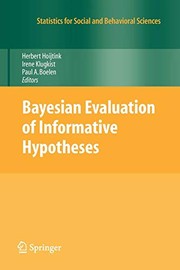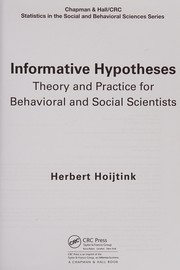
Informative hypotheses
Herbert Hoijtink · 2011
Where to buy
Check today’s price on Amazon. We do not show prices because they change daily.
View on AmazonAffiliate link. As an Amazon Associate we earn from qualifying purchases.
About the book
"When scientists formulate their theories, expectations, and hypotheses, they often use statements like: "I expect mean A to be bigger than means B and C"; "I expect that the relation between Y and both X1 and X2 is positive"; and "I expect the relation between Y and X1 to be stronger than the relation between Y and X2". Stated otherwise, they formulate their expectations in terms of inequality constraints among the parameters in which they are interested, that is, they formulate Informative Hypotheses.There is currently a sound theoretical foundation for the evaluation of informative hypotheses using Bayes factors, p-values and the generalized order restricted information criterion. Furthermore, software that is often free is available to enable researchers to evaluate the informative hypotheses using their own data. The road is open to challenge the dominance of the null hypothesis for contemporary research in behavioral, social, and other sciences"-- "Preface Providing advise to behavioral and social scientists is the most interesting and challenging part of my work as a statistician. It is an opportunity to apply statistics in situations that usually have no resemblance to the clear cut examples discussed in most text books on statistics. A fortiori, it is not unusual that scientists have questions to which I do not have a straightforward answer, either because the question has not yet been considered by statisticians, or, because existing statistical theory can not easily be applied because there is no software with which it can be implemented. An example of the latter are Informative Hypotheses. When I question scientists with respect to their theories, expectations and hypotheses, they often respond with statements like: I expect mean A to be bigger than means B and C"; I expect that the relation between Y and both X1 and X2 is positive"; and I expect the relation between Y and X1 to be stronger than the relation between Y and X2". Stated otherwise, they formulate their expectations in terms of inequality constraints among the parameters in which they are interested, that is, they formulate Informative Hypotheses. In this book the evaluation of informative hypotheses is introduced for behavioral and social scientists. Chapters 1 and 2 introduce the univariate and multivariate normal lin- ear models and the informative hypotheses that can be formulated in the context of these models. An accessible account of Bayesian evaluation of informative hypothe
Book details
- Year
- 2011
- Language
- English
- Series
- Chapman & Hall/CRC statistics in the social and behavioral sciences
- Publisher
- Chapman and Hall/CRC
- Editions
- 5
- Pages
- 227
- ISBN
- 9781439880517
Data source: Wikidata