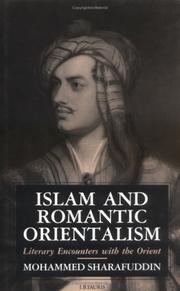
Islam and romantic orientalism
Mohammed Sharafuddin · 1996
Where to buy
Amazon’s price changes daily, so the most accurate place to see it is there, at the moment you buy.
View on AmazonAbout the book
This important intervention in the debate on orientalism takes a fresh look at some of the main literary texts from the Romantic period explored in Edward Said's classic work. Mohammed Sharafuddin recognizes elements of truth in the thesis that Western writers and scholars created an image of the Muslim 'Orient' as a place of tyranny, unreason and immorality destined to be subjected and exploited by the civilized West. However, he argues that in the work of such writers as Southey, Byron, Moore, Landor and Beckford, the world of Islam appears not as an antithesis to the world of European civilization, but rather as an alternative cultural reality with its own values. He explores the sense in which the work of these writers opens up the possibility for a knowledge of the Orient that does not simply confirm ideologies of Western power and hegemony. Themes of the exotic and the fanciful in fact had the effect of challenging the boundaries of Western-centred culture and thus created the conditions for a more positive perception of other cultures. Although this did not translate into a new political and literary openness, it did at least demonstrate the existence of a more complex cultural interaction between East and West. This admission has been completely sidelined in many recent debates on orientalism. Above all, Sharafuddin argues that the Romantic writers in question present a rich and subversive view of the Orient not simply informed by inherited stereotypes. . Islam and Romantic Orientalism will be of great interest to those concerned with the debate about orientalism and post-colonialism and to students of nineteenth-century English literature.
Book details
- Year
- 1996
- Language
- English
- Publisher
- I. B. Tauris
- Editions
- 2
- Pages
- 256
- ISBN
- 9781860640261
Data source: Wikidata