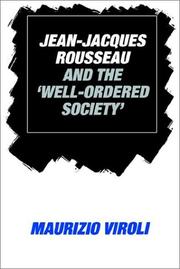
Jean-Jacques Rousseau and the "well-ordered society"
Maurizio Viroli · 2003
Where to buy
Amazon’s price changes daily, so the most accurate place to see it is there, at the moment you buy.
View on AmazonAbout the book
This book studies a central but hitherto neglected aspect of Rousseau's political thought: the concept of social order and its implications for the ideal society which he envisages. The antithesis between order and disorder is a fundamental theme in Rousseau's work, and the author takes it as the basis for this study. In contrast with a widely held interpretation of Rousseau's philosophy, the author argues that natural and political order are by no means the same for Rousseau. He explores the differences and interrelations between the different types of order which Rousseau describes, and shows how the philosopher constructed his final doctrine of the just society, which can be based only on every citizen's voluntary and knowing acceptance of the social contract and on the promotion of virtue above ambition. The author also shows the extent of Rousseau's debt to the republican tradition, and above all to Machiavelli, and revises the image of Rousseau as a disciple of the natural-law school.
Book details
- Year
- 2003
- Language
- English
- Publisher
- Cambridge University Press
- Editions
- 1
- Pages
- 255
- ISBN
- 9780521531382
Data source: Wikidata
More by Maurizio Viroli