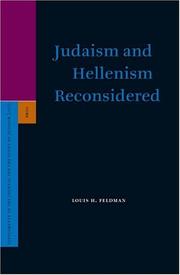
Jew and Gentile in the ancient world
Louis H. Feldman · 1993
Where to buy
Amazon’s price changes daily, so the most accurate place to see it is there, at the moment you buy.
View on AmazonAbout the book
Relations between Jews and non-Jews in the Hellenistic-Roman period were marked by suspicion and hate, maintain most studies of that topic. But if such conjectures are true, asks Louis Feldman, how did Jews succeed in winning so many adherents, whether full-fledged proselytes or "sympathizers" who adopted one or more Jewish practices? Systematically evaluating attitudes toward Jews from the time of Alexander the Great to the fifth century A.D., Feldman finds that Judaism elicited strongly positive and not merely unfavorable responses from the non-Jewish population. Jews were a vigorous presence in the ancient world, and Judaism was strengthened substantially by the development of the Talmud. Although Jews in the Diaspora were deeply Hellenized, those who remained in Israel were able to resist the cultural inroads of Hellenism and even to initiate intellectual counterattacks. Feldman draws on a wide variety of material, from Philo, Josephus, and other Graeco-Jewish writers through the Apocrypha, the Pseudepigrapha, the Church Councils, Church Fathers, and imperial decrees to Talmudic and Midrashic writings and inscriptions and papyri. What emerges is a rich description of a long era to which conceptions of Jewish history as uninterrupted weakness and suffering do not apply.
First sentence: It always comes as a surprise-perhaps even a shock-that the two peoples who have most profoundly influenced Western civilization, the Jews and the Greeks, seem to have been just about unaware of each other, at least in a cultural sense, until the fifth century B.C.E. at the very earliest.
Book details
- Year
- 1993
- Language
- English
- Publisher
- Princeton University Press
- Editions
- 3
- Pages
- 692
- ISBN
- 9780691029276
Data source: Wikidata
More by Louis H. Feldman