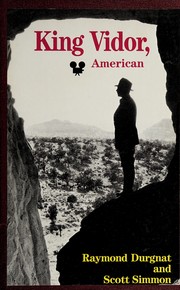
King Vidor, American
Raymond Durgnat · 1992
Where to buy
Amazon’s price changes daily, so the most accurate place to see it is there, at the moment you buy.
View on AmazonAbout the book
Hollywood director King Vidor (1894-1982) was acknowledged as a master by movie showmen and cinema critics alike, but the range of his films made him impossible to pigeonhole. With The Big Parade (1925), he created the first modern war film and MGM's first major hit. The Crowd (1928) looked at "ordinary people" in city jungles. Hallelujah (1929) was the first all-black major-studio feature. To the Great Depression, Vidor responded with Our Daily Bread (1934), the politically intricate saga of a rural cooperative. Other Vidor films spoke directly to the moviegoing public: that three-handkerchief male weepie, The Champ (1931); and that key women's drama, Stella Dallas (1937). His high-passion postwar melodramas, spurned by contemporary reviewers, have gained champions each year: the epic western Duel in the Sun (1946); Ayn Rand's ultra-right-wing The Fountainhead (1949); and the violent and morbid Beyond the Forest (1949) and Ruby Gentry (1952). This book is the first in-depth story of Vidor's half-century-long career, from his first attempts to rival Hollywood in his home state of Texas through the complex interplay of his independent spirit with "classic" Hollywood's rules about public taste. The title King Vidor, American, celebrates Vidor as a representative man, full of the conflicting generosity and ferocity in the national ethos: with his violent mixture of pioneering optimism and noir torments, of transcendentalism and puritanism, of spiritual verve and physical practicality, of liberal conscience and Social Darwinist savagery, of male dominance and female conciliation. Like Whitman, he contains multitudes. Never narrowly auteurist, this book is a wide ranging integration of film history, political thought, and popular culture.--Adapted from dust jacket.
Book details
- Year
- 1992
- Language
- English
- Publisher
- University of California Press
- Editions
- 1
- Pages
- 382
- ISBN
- 9780520057982
Data source: Wikidata
More by Raymond Durgnat