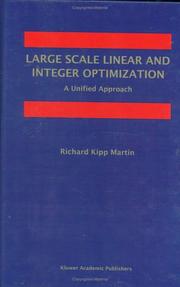
Large Scale Linear and Integer Optimization: A Unified Approach
Richard Kipp Martin · 1999
Where to buy
Check today’s price on Amazon. We do not show prices because they change daily.
View on AmazonAffiliate link. As an Amazon Associate we earn from qualifying purchases.
About the book
There is a growing need in major industries such as airline, trucking, financial engineering, etc. to solve very large linear and integer linear optimization problems. Because of the dramatic increase in computing power, it is now possible to solve these problems. Along with the increase in computer power, the mathematical programming community has developed better and more powerful algorithms to solve very large problems. These algorithms are of interest to many researchers in the areas of operations research/management science, computer science, and engineering. In this book, Kipp Martin has systematically provided users with a unified treatment of the algorithms and the implementation of the algorithms that are important in solving large problems. Parts I and II of Large Scale Linear and Integer Programming provide an introduction to linear optimization using two simple but unifying ideas-projection and inverse projection. The ideas of projection and inverse projection are also extended to integer linear optimization. With the projection-inverse projection approach, theoretical results in integer linear optimization become much more analogous to their linear optimization counterparts. Hence, with an understanding of these two concepts, the reader is equipped to understand fundamental theorems in an intuitive way. Part III presents the most important algorithms that are used in commercial software for solving real-world problems. Part IV shows how to take advantage of the special structure in very large scale applications through decomposition. Part V describes how to take advantage of special structureby modifying and enhancing the algorithms developed in Part III. This section contains a discussion of the current research in linear and integer linear programming. The author also shows in Part V how to take different problem formulations and appropriately `modify' them so that the algorithms from Part III are more efficient. Again, the projection and inverse projection concepts are used in Part V to present the current research in linear and integer linear optimization in a very unified way. While the book is written for a mathematically mature audience, no prior knowledge of linear or integer linear optimization is assumed. The audience is upper-level undergraduate students and graduate students in computer science, applied mathematics, industrial engineering and operations research/management science. Course work in linear algebra and analysis is suff
Book details
- Year
- 1999
- Language
- English
- Publisher
- Springer US
- Editions
- 1
- Pages
- 740
- ISBN
- 9781461372585
Data source: Wikidata