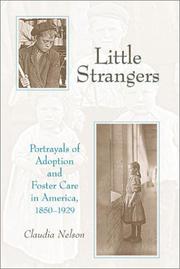
Little Strangers
Claudia Nelson · 2003
Where to buy
Amazon’s price changes daily, so the most accurate place to see it is there, at the moment you buy.
View on AmazonThis is an affiliate link: if you buy through it, the site earns a small commission at no extra cost to you, which helps us bring quality content and maintain the site. As an Amazon Associate we earn from qualifying purchases.
About the book
"When Massachusetts passed America's first comprehensive adoption law in 1851, the usual motive for taking in an unrelated child was presumed to be the need for cheap help. Institutions housed young children but expected to place them as they became old enough to be useful; foster parents contracted to trade care for the child's services. But by 1929 - the first year that every state had an adoption law - the adoptee's main function was seen as emotional. Adopting strangers' children had become commonplace, and infants, who perform no work, were now more readily placed than older children." "Little Strangers examines the representations of adoption and foster care produced over the intervening years. Claudia Nelson argues that adoption texts reflect changing attitudes toward many important social issues, including immigration and poverty, heredity and environment, individuality and citizenship, gender, and the family. She considers orphan fiction for children, magazine stories and articles, legal writings, social work conference proceedings, and discussions of heredity and child psychology. Nelson's ambitious scope provides for an analysis of the extent to which specialist and mainstream adoption discourse overlapped, as well as the ways in which adoption and foster care captivated the public imagination."--Jacket.
First sentence: The 1885 poem "Little Orphant Annie," by Hoosier versifier James Whitcomb Riley, profiles a girl "bound out" to earn her own way in the world.
Book details
- Year
- 2003
- Language
- English
- Publisher
- Indiana University Press
- Editions
- 3
- Pages
- 212
- ISBN
- 9780253342249
Data source: Wikidata
More by Claudia Nelson