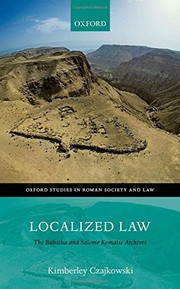
Localized Law
Kimberley Czajkowski · 2017
Where to buy
Check today’s price on Amazon. We do not show prices because they change daily.
View on AmazonAffiliate link. As an Amazon Associate we earn from qualifying purchases.
About the book
In the early second century CE, two Jewish women, Babatha and Salome Komaise, lived in the village of Maoza on the southern coast of the Dead Sea, which came under direct Roman rule in 106 CE. The archives these two women left behind provide a tantalizing glimpse into the ways in which the inhabitants of this region interacted with their new rulers and how this affected the practice of law in this part of the Roman Empire. The papers provide details of the women's property, marriages, and disputes, and are remarkable in their legal diversity : Nabataean, Roman, Greek, and Jewish legal elements are all in evidence. Consequently, identifying the supposed 'operative law' of the documents has proven a highly contentious task, with scholarly advocates of each of these traditions have failed to reach any true consensus. This volume proposes a change in focus : instead of attempting to idenify the 'legal system' behing the documents, it seeks instead to understand the 'legal culture' of the community that produced them. Through a series of case studies of the ways in which the people involved in the creation of the papyri variously perceived and approached their legal transactions, it argues that concentration on these different agents' understandings will ultimately help scholars to better understand the actual funtioning of law and justice both in this particular village and in other small communities in the Roman Empire --Back cover.
Book details
- Year
- 2017
- Language
- English
- Publisher
- Oxford University Press
- Editions
- 1
- Pages
- 256
- ISBN
- 9780198777335
Data source: Wikidata