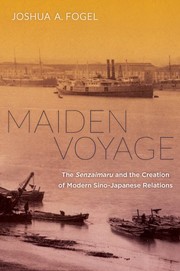
Maiden Voyage
Joshua A. Fogel · 2014
Where to buy
Amazon’s price changes daily, so the most accurate place to see it is there, at the moment you buy.
View on AmazonThis is an affiliate link: if you buy through it, the site earns a small commission at no extra cost to you, which helps us bring quality content and maintain the site. As an Amazon Associate we earn from qualifying purchases.
About the book
" After centuries of virtual isolation, during which time international sea travel was forbidden outside of Japan's immediate fishing shores, Japanese shogunal authorities in 1862 made the unprecedented decision to launch an official delegation to China by sea. Concerned by the fast-changing global environment, they had witnessed the ever-increasing number of incursions into Asia by European powers-not the least of which was Commodore Perry's arrival in Japan in 1853-54 and the forced opening of a handful of Japanese ports at the end of the decade. The Japanese reasoned that it was only a matter of time before they too encountered the same unfortunate fate as China; their hope was to learn from the Chinese experience and to keep foreign powers at bay. They dispatched the Senzaimaru to Shanghai with the purpose of investigating contemporary conditions of trade and diplomacy in the international city. Japanese from varied domains, as well as shogunal officials, Nagasaki merchants, and an assortment of deck hands, made the voyage along with a British crew, spending a total of ten weeks observing and interacting with the Chinese and with a handful of Westerners. Roughly a dozen Japanese narratives of the voyage were produced at the time, recounting personal impressions and experiences in Shanghai. The Japanese emissaries had the distinct advantage of being able to communicate with their Chinese hosts by means of the "brush conversation" (written exchanges in literary Chinese). For their part, the Chinese authorities also created a paper trail of reports and memorials concerning the Japanese visitors, which worked its way up and down the bureaucratic chain of command. This was the first official meeting of Chinese and Japanese in several centuries. Although the Chinese authorities agreed to few of the Japanese requests for trade relations and a consulate, nine years later China and Japan would sign the first bilateral treaty of amity in their history, a completely equal treaty. East Asia-and the diplomatic and trade relations between the region's two major players in the modern era-would never be the same"--
Book details
- Year
- 2014
- Language
- English
- Publisher
- University of California Press
- Editions
- 4
- Pages
- 316
- ISBN
- 9781322058795
Data source: Wikidata
More by Joshua A. Fogel