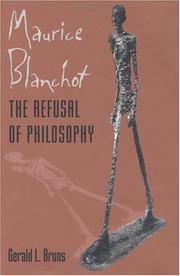
Maurice Blanchot
Gerald L. Bruns · 1997
Where to buy
Amazon’s price changes daily, so the most accurate place to see it is there, at the moment you buy.
View on AmazonThis is an affiliate link: if you buy through it, the site earns a small commission at no extra cost to you, which helps us bring quality content and maintain the site. As an Amazon Associate we earn from qualifying purchases.
About the book
As a novelist, essayist, critic, and theorist, Maurice Blanchot has earned tributes from authors as diverse as Jacques Derrida, Giles Deleuze, and Emmanuel Levinas. But their praise has told us little about what Blanchot's work actually says and why it has been so influential. In the first comprehensive study of this important French writer to appear in English, Gerald Bruns ties Blanchot's writings to each other and to the works of his contemporaries, including the poet Paul Celan. In a series of close readings, Bruns addresses the philosophical and political questions that have surrounded Blanchot and his writings for decades. He describes what is creative in Blanchot's readings of Heidegger's controversial works and examines Blanchot's conception of poetry as an inquiry into the limits of philosophy, rationality, and power.
First sentence: In his last major text, L'écriture du désastre (1980), Maurice Blanchot writes: "A philosopher who would write as a poet would be aiming for his own destruction.
Book details
- Year
- 1997
- Language
- English
- Publisher
- The Johns Hopkins University Press
- Editions
- 2
- Pages
- 376
- ISBN
- 9780801881992
Data source: Wikidata
More by Gerald L. Bruns