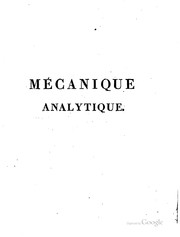
Mécanique analytique
Joseph Louis Lagrange, A. Boissonnade, V. N. Vagliente, Joseph Bertrand · 1811
Where to buy
Amazon’s price changes daily, so the most accurate place to see it is there, at the moment you buy.
View on AmazonThis is an affiliate link: if you buy through it, the site earns a small commission at no extra cost to you, which helps us bring quality content and maintain the site. As an Amazon Associate we earn from qualifying purchases.
About the book
J. L. Lagrange is a name well known to students in all branches of mathematics and applied mathematics. But by far his most famous work deals with mechanics - the Mecanique Analytique. In this work, he used the Principle of Virtual Work as the foundation for all of mechanics and thereby brought together statics, hydrostatics, dynamics and hydrodynamics. His approach differed significantly from the mechanics of Newton and the physical approach to mechanics of Laplace and Poisson. The difference is due primarily to the introduction by Lagrange of a fictitious constraint force. The purpose of the constraint force is to enforce an algebraic relation between the coordinates of the parts of a continuous body or between various bodies. Moreover, the physical origin of this force does not have to be known. From this point, Lagrange utilizes the methodology of the Calculus of Variations - a methodology which he himself developed - to vary the configuration of a system in statics or the path of a system in dynamics in order to obtain the governing differential equations. Audience: Historians of science, mathematicians, physicists and engineers, and scholars specializing in classical mechanics, celestial mechanics, mathematics of mechanics and mechanics in general.
Book details
- Year
- 1811
- Language
- English
- Publisher
- Cambridge University Press
- Editions
- 16
- ISBN
- 9780511701795
Data source: Wikidata
More by Joseph Louis Lagrange