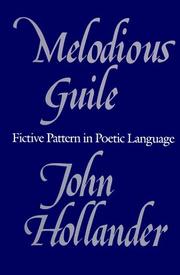
Melodious guile
John Hollander · 1990
Where to buy
Check today’s price on Amazon. We do not show prices because they change daily.
View on AmazonAffiliate link. As an Amazon Associate we earn from qualifying purchases.
About the book
Demonstrating a poet's imaginative ear and a critic's range of concern, John Hollander here writes about the "melodious guile" of poetry, explaining how poems frame parables about themselves. Hollander considers works by Spenser, Milton, Wordsworth, chiefly, plus a range of other poets including Chaucer, Keats, Rossetti, Tennyson, Frost, Stevens, and Auden. He also presents certain poems of his own, showing how they anticipate and exemplify the observations contained in this volume. Hollander discusses different levels of patterning in verse, examining how such rhetorical schemes as rhyme, word order, and stanza form not only support and display figures of speech, but often themselves become the strongest and most moving of metaphors. He explains that devices such as rhetorical questions and imperatives, inversions, egregiously long lines, and sonnet pattern and refrain all exist in poetry to tell stories about the way the poems operate. He also focuses on larger issues in poetics in terms of their figurative use: concepts such as "character" and "occasion" and, finally, the ways in which the differences between example and metaphor point up the contrasts between philosophers' and poets' stances toward their own language. Throughout, because of his view that poetry does indeed represent the world of which it is part, Hollander implicitly opposes certain positions taken both by recent literary theory and its self-designated "humanist" antagonists.
Book details
- Year
- 1990
- Language
- English
- Publisher
- Yale University Press
- Editions
- 1
- Pages
- 272
- ISBN
- 9780300049046
Data source: Wikidata
More by John Hollander