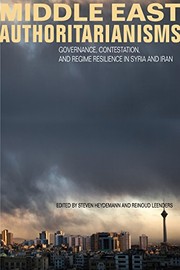
Middle East authoritarianisms
Steven Heydemann, Reinoud Leenders · 2012
Where to buy
Amazon’s price changes daily, so the most accurate place to see it is there, at the moment you buy.
View on AmazonAbout the book
The developments of early 2011 have left the political landscape of the Middle East changed but recognizable. Even as urgent struggles continue, it remains clear that authoritarianism will survive this transformational moment. The study of authoritarian governance, therefore, remains essential for our understanding of the political dynamics and inner workings of regimes across the region. The contributors to this volume consider the Syrian and Iranian regimes--what they share in common and what distinguishes them. Too frequently, authoritarianism has been assumed to be a generic descriptor of the region, and differences among regimes have been overlooked. But as the political trajectories of Middle Eastern states diverge in years ahead, with some perhaps consolidating democratic gains while others remaining under distinct and resilient forms of authoritarian rule, understanding variations in modes of authoritarian governance and the attributes that promote regime resilience becomes an increasingly urgent priority.
Book details
- Year
- 2012
- Language
- English
- Series
- Stanford studies in Middle Eastern and Islamic societies and cultures
- Publisher
- Stanford University Press
- Editions
- 3
- Pages
- 292
- ISBN
- 9780804783019
Data source: Wikidata
More by Steven Heydemann