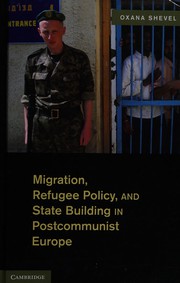
Migration, refugee policy, and state building in postcommunist Europe
Oxana Shevel · 2011
Where to buy
Amazon’s price changes daily, so the most accurate place to see it is there, at the moment you buy.
View on AmazonAbout the book
"Why do similar postcommunist states respond differently to refugees, with some being more receptive than others? Why do some states privilege certain refugee groups, while other states do not? This book presents a theory to account for this puzzle, and it centers on the role of the politics of nation-building and of the office of the UN High Commissioner for Refugees (UNHCR). A key finding of the book is that when the boundaries of a nation are contested (and thus there is no consensus on which group should receive preferential treatment in state policies), a political space for a receptive and nondiscriminatory refugee policy opens up. The book speaks to the broader questions of how nationalism matters after communism, and under what conditions and through what mechanisms international actors can influence domestic polices. The analysis is based on extensive primary research the author conducted in four languages in the Czech Republic, Poland, Russia, and Ukraine"--
Book details
- Year
- 2011
- Language
- English
- Publisher
- Cambridge University Press
- Editions
- 8
- Pages
- 287
- ISBN
- 9780521764797
Data source: Wikidata