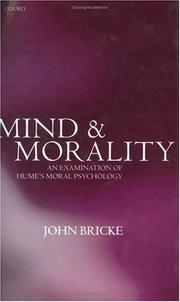
Mind and morality
John Bricke · 1996
Where to buy
Check today’s price on Amazon. We do not show prices because they change daily.
View on AmazonAffiliate link. As an Amazon Associate we earn from qualifying purchases.
About the book
John Bricke presents a philosophical study of the theory of mind and morality that David Hume developed in his Treatise of Human Nature and other writings. The chief elements in this theory of mind are Hume's accounts of reasons for action and of the complex interrelations of desire, volition, and affection. On this basis, Professor Bricke lays out and defends Hume's thoroughgoing non-cognitivist theory of moral judgement, and shows that cognitivist and standard sentimentalist readings of Hume are unsatisfactory, as are the usual interpretations of his views on the connections between morality, justice, and convention. Hume rejects any conception of moral beliefs and moral truths. He understands morality in terms of distinctive desires and other sentiments that arise through the correction of sympathy. He represents moral desires as prior to the other moral sentiments. Morality, he holds, in part presupposes conventions for mutual interest; it is not, however, itself a matter of convention. Mind and Morality demonstrates that Hume's sophisticated moral conativism sets a challenge that recent cognitivist theories of moral judgement cannot readily meet, and his subtle treatment of the interplay of morality and convention suggests significant limitations to recent conventionalist and contractarian accounts of morality's content.
Book details
- Year
- 1996
- Language
- English
- Publisher
- Oxford University Press, USA
- Editions
- 1
- Pages
- 274
- ISBN
- 9780198250111
Data source: Wikidata