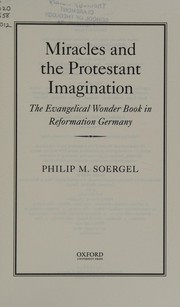
Miracles and the Protestant imagination
Philip M. Soergel · 2012
Where to buy
Amazon’s price changes daily, so the most accurate place to see it is there, at the moment you buy.
View on AmazonThis is an affiliate link: if you buy through it, the site earns a small commission at no extra cost to you, which helps us bring quality content and maintain the site. As an Amazon Associate we earn from qualifying purchases.
About the book
"The Reformation's war against the saints and their miracles is well known. The story of the Protestant Reformers' embrace of natural wonders as miracles that could similarly spur piety and moral discipline is much less familiar. In Miracles and the Protestant Imagination, Philip M. Soergel examines the sixteenth-century Lutheran wonder books, works filled with accounts of monstrous births, celestial apparitions, natural disasters, plagues, and other seemingly aberrant events occurring in the natural world. Soergel traces the inspiration behind these books to a widespread appropriation of wonders that was taking place throughout late-medieval and early-modern Europe. As sixteenth-century rulers stocked their curiosity cabinets with all manner of strange and confounding bits of nature collected from the far corners of the globe, evangelical theologians, too, compiled enormous compendia filled with accounts of fantastic events long recorded in the natural world. Many embraced such tales to satisfy an innate curiosity about nature and its often incomprehensible processes, but Germany's devout evangelicals relied upon them to warn of imminent Apocalypse, to drive home the full scope of human depravity, and to encourage the repentant to keep the Law of an angry, Deuteronomic God. Luther had dismissed natural signs as inferior when compared against the testimony of the scriptures. Nevertheless, inspired by Melanchthon and other contemporaries who embraced history, natural philosophy, and rhetoric as proofs for Christian doctrine, the authors of late-Reformation wonder books fashioned natural signs into powerful defenses of treasured evangelical principles. In so doing, their works revealed the tensions as well as fears at play within a maturing Reformation movement as it faced mounting internal dissension and external pressures from Calvinism and resurgent Catholicism." -- Publisher's description.
Book details
- Year
- 2012
- Language
- English
- Publisher
- Oxford University Press
- Editions
- 4
- Pages
- 234
- ISBN
- 9780199844661
Data source: Wikidata
More by Philip M. Soergel