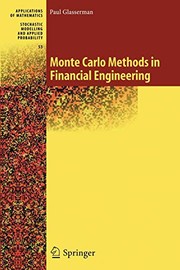
Monte Carlo Methods in Financial Engineering
Paul Glasserman · 2013
Where to buy
Amazon’s price changes daily, so the most accurate place to see it is there, at the moment you buy.
View on AmazonThis is an affiliate link: if you buy through it, the site earns a small commission at no extra cost to you, which helps us bring quality content and maintain the site. As an Amazon Associate we earn from qualifying purchases.
About the book
Monte Carlo simulation has become an essential tool in the pricing of derivative securities and in risk management. These applications have, in turn, stimulated research into new Monte Carlo methods and renewed interest in some older techniques. This book develops the use of Monte Carlo methods in finance and it also uses simulation as a vehicle for presenting models and ideas from financial engineering. It divides roughly into three parts. The first part develops the fundamentals of Monte Carlo methods, the foundations of derivatives pricing, and the implementation of several of the most important models used in financial engineering. The next part describes techniques for improving simulation accuracy and efficiency. The final third of the book addresses special topics: estimating price sensitivities, valuing American options, and measuring market risk and credit risk in financial portfolios. The most important prerequisite is familiarity with the mathematical tools used to specify and analyze continuous-time models in finance, in particular the key ideas of stochastic calculus. Prior exposure to the basic principles of option pricing is useful but not essential. The book is aimed at graduate students in financial engineering, researchers in Monte Carlo simulation, and practitioners implementing models in industry.
Book details
- Year
- 2013
- Language
- English
- Publisher
- Springer London, Limited
- Editions
- 2
- Pages
- 596
- ISBN
- 9780387216171
Data source: Wikidata