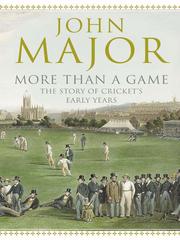
More Than A Game
John Major, John Roy Major · 2008
Where to buy
Amazon’s price changes daily, so the most accurate place to see it is there, at the moment you buy.
View on AmazonThis is an affiliate link: if you buy through it, the site earns a small commission at no extra cost to you, which helps us bring quality content and maintain the site. As an Amazon Associate we earn from qualifying purchases.
About the book
The former Prime Minister examines the early history of one of the great loves of his life in a book that sheds new light on the summer game’s social origins.All his life John Major has loved cricket. In ‘More Than a Game’ he examines it from its origins up to the coming of the First World War. Along the way he considers the crucial role of the wealthy patrons who gambled huge sums on early matches; the truth behind the legends that have grown up around the famous Hambledon Club; changes in rules and techniques, including the transition from underarm to overarm bowling; the long-standing, but often blurred, distinction between 'gentlemen' and 'players'; the coming of the MCC and its role as the supreme arbiter of the game; the spread of cricket throughout the British Empire; and the emergence of the county game and international competition.It is a story rich in anecdote and colourful characters. Many of the great names from the 'Golden Age' of cricket – C.B. Fry, Ranjitsinhji, 'Demon' Spofforth and of course the towering figure of W.G. Grace – are still well-known today. But long before then the game already had its stars: men like the Kentish innkeeper's son 'Lumpy' Stevens, who played at the highest level until he was nearly sixty; 'Silver Billy' Beldham, who was taught how to play by a gingerbread baker; the notoriously avaricious and ill-tempered Lord Frederic Beauclerk, a direct descendant of Charles II and Nell Gwynne; and the mighty 'Lion of Kent' Alfred Mynn.
Book details
- Year
- 2008
- Language
- English
- Publisher
- Harper Perennial
- Editions
- 3
- Pages
- 433
- ISBN
- 9780007183654
Data source: Wikidata