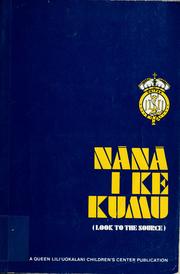
Nānā i ke kumu (Look to the Source) vol 1
Mary Kawena Pukui, E.W. Haertig, Catherine Lee · 1983
Where to buy
Amazon’s price changes daily, so the most accurate place to see it is there, at the moment you buy.
View on AmazonAbout the book
Nana I Ke Kumu (Look to the Source) is dedicated to the families and children of Hawaii. It is a source book of Hawaiian cultural practices, concepts and beliefs which illustrate the wisdom and dignity contained in the cultural roots of every Hawaiian child.The Hawaiian lived for many years isolated from the rest of the world, with a viable culture that met the needs of a thriving, industrious and religious people. Then came the foreigner with his technology and Judeao-Christian culture. He saw the native beliefs as pagan and inferior, and superimposed his culture. In order to gain acceptance, avoid ridicule and disapproval, the Hawaiian gradually adapted to Western ways. However, he secretly hung on to some of the beliefs and ways of his own culture. The confusion in his sense of identity which resulted exists today. For many Hawaiian families today, only the negatives, often in garbled fashion, have persisted. This is complicated further by mergers or conflicts of Hawaiian convictions with other ethnic or religious precepts. Forgotten are the positives in the culture, such as: the importance of the family (ohana); the respect for seniors (kupuna); insuring harmonious interdependence within the ohana through regular family therapy (hooponopono); dealing with each successive layer of trouble (mahiki); forgiving fully and completely (mihi);) and freeing each other completely (kala). It is this knowledge that the Hawaiian needs to recapture. The objectives of this work are to provide factual information as accurately as possible in a subject that reaches back to unwritten history and legend, to clarify Hawaiian concepts, and to examine their applicability to modern life.
Book details
- Year
- 1983
- Language
- English
- Publisher
- Hui Hanai
- Editions
- 1
- ISBN
- 9780916630133
Data source: Wikidata
More by Mary Kawena Pukui