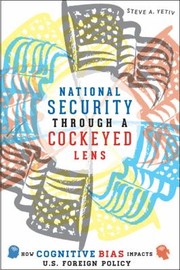
National Security Through A Cockeyed Lens How Cognitive Bias Impacts Us Foreign Policy
Steve A. Yetiv · 2013
Where to buy
Amazon’s price changes daily, so the most accurate place to see it is there, at the moment you buy.
View on AmazonAbout the book
"What are key mental errors that can undermine good decision making? Drawing on four decades of psychological, historical, and political science research on cognitive biases, this book illuminates key pitfalls in how we and our leaders make decisions. It shows in five case studies of American foreign and energy policy that such errors--a dozen different cognitive biases--have been more important in shaping and impacting U.S. national interests than we currently understand. In so doing, it also sheds light on U.S. foreign policy toward and interests in the Middle East. That story prominently features non-psychological explanations, but cognitive biases exercised by American and foreign actors also represent a slice of the story that is worth revealing. As examples, the book shows how the distorted cognitive lens of Al-Qaeda leaders contributed to the September 11 attacks and the ongoing conflict with America and the West; how overconfidence impacted America's decision to invade Iraq in 2003; and how short term thinking--a prominent cognitive bias--hurts America's ability to develop a comprehensive energy policy, making the Middle East more important to the United States and enhancing its proclivity to be involved in the region. The book is aimed chiefly at students and the lay public, though academics may benefit from it"--
Book details
- Year
- 2013
- Language
- English
- Publisher
- Johns Hopkins University Press
- Editions
- 1
- Pages
- 155
- ISBN
- 9781421411255
Data source: Wikidata
More by Steve A. Yetiv