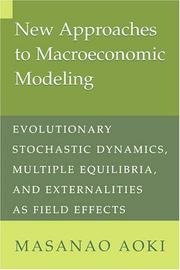
New approaches to macroeconomic modeling
Masanao Aoki · 1996
Where to buy
Amazon’s price changes daily, so the most accurate place to see it is there, at the moment you buy.
View on AmazonAbout the book
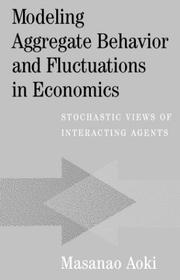
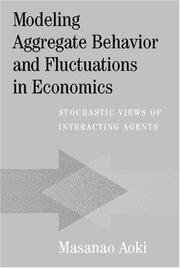
This book contributes substantively to the current state of the art of macroeconomic modeling by providing a method for modeling large collections of possibly heterogeneous agents subject to nonpairwise externality called field effects, that is, feedback of aggregate effects on individual agents or agents using state-dependent strategies. By adopting a level of microeconomic description that keeps track of compositions of fractions of agents by types or strategies, time evolution of the microeconomic states is described by backward Chapman-Kolmogorov equations. Macroeconomic dynamics naturally arise from these equations by expansion of the solutions in some power series of the number of participants. Specification of the microeconomic transition rates thus leads to macroeconomic dynamic models. This approach provides a consistent way for dealing with multiple equilibria of macroeconomic dynamics by ergodic decomposition and associated calculations of mean first passage times, and stationary probabilities of equilibria further provide useful information on macroeconomic behavior.
First sentence: This chapter introduces concepts and techniques that are further developed in the main body of this book, mostly via simple examples.
Book details
- Year
- 1996
- Language
- English
- Publisher
- Cambridge University Press
- Editions
- 3
- Pages
- 306
- ISBN
- 9780521637695
Data source: Wikidata
More by Masanao Aoki