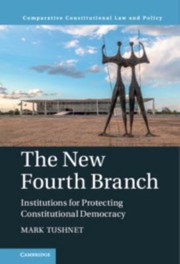
New Fourth Branch
Mark Tushnet · 2021
Where to buy
Amazon’s price changes daily, so the most accurate place to see it is there, at the moment you buy.
View on AmazonThis is an affiliate link: if you buy through it, the site earns a small commission at no extra cost to you, which helps us bring quality content and maintain the site. As an Amazon Associate we earn from qualifying purchases.
About the book
"Chapter Nine of South Africa's Constitution is titled, "State Institutions Protecting Constitutional Democracy." Its list of institutions that "strengthen constitutional democracy" includes the Public Prosecutor, the Human Rights Commission, the Auditor-General, and the Electoral Commission. Seen in the context of the Constitution's written text, these institutions form a branch on a par with Parliament and the President. Textual placement may not be important in itself. The authors of the South African Constitution were on to something important, though. They saw that the traditional Montesqueian enumeration of three and only three branches of government no longer identified the complete set of desiderata for institutional design. Dissatisfaction with the Montesquiean enumeration was apparent as well in Roberto Mangabeira Unger's False Necessity, published in 1987. That enumeration, Unger wrote, was "dangerous" because it "generates a stifling and perverse institutional logic...." The solution for Unger lay in multiplying the number of branches. He offered several examples: a branch "especially charged with enlarging access to the means of communication, information, and expertise," and a branch - labeled the "destabilization branch" - designed "to give every transformative practice a chance.""--
Book details
- Year
- 2021
- Language
- English
- Publisher
- University of Cambridge ESOL Examinations
- Editions
- 3
- Pages
- 186
- ISBN
- 9781009048491
Data source: Wikidata
More by Mark Tushnet