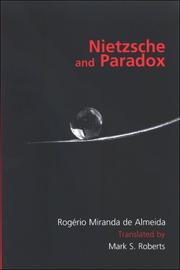
Nietzsche and paradox
Rogério Miranda de Almeida · 2006
Where to buy
Amazon’s price changes daily, so the most accurate place to see it is there, at the moment you buy.
View on AmazonAbout the book
This book analyzes the paradoxes that flow through and fundamentally characterize Nietzsche's texts. Examining Nietzsche's main works, such as: "Birth of Tragedy;" "Human, All Too Human;" "The Gay Science;" "Thus Spoke Zarathustra;" "Beyond Good and Evil;" "On the Genealogy of Morals;" "The Antichrist," as well as the posthumous writings, Rogério Miranda de Almeida shows how these texts are open to a multiplicity of truths that unfold through a process of continous reinterpretation and revaluation. This is the reason why he prefers to use the word "paradox," instead of "contradiction" or "opposition," when he examines Nietzsche's conception of metaphysics, religion, art, science, and philosophy. Indeed, Miranda de Almeida acknowledges that the main question in Nietzsche's thought and writings is the interplay of forces and drives, encroachment and surrender, construction and destruction, satisfaction and dissatisfaction, pleasure and displeasure, pain and delight, overcoming and transformation. Thus, he never ceases to underscore the endless dynamics of perspectives, evaluations and truths that Nietzsche creates and annihilates, rebuilds and transforms. This book is also available in French, by Presses Universitaires de Strasbourg, under the title: "Nietzsche et le paradoxe." It was also translated into Portuguese, by Edições Loyola, under the title: "Nietzsche e o paradoxo."
Book details
- Year
- 2006
- Language
- English
- Publisher
- State University of New York Press
- Editions
- 1
- Pages
- 218
- ISBN
- 9780791468890
Data source: Wikidata
More by Rogério Miranda de Almeida