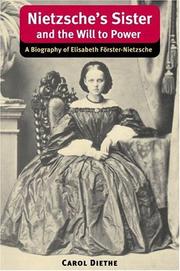
Nietzsche's Sister and the Will to Power
Carol Diethe, Carol Diethe · 2003
Where to buy
Amazon’s price changes daily, so the most accurate place to see it is there, at the moment you buy.
View on AmazonAbout the book
"Elisabeth Forster-Nietzsche was two years younger than her brother, Friedrich Nietzsche, and outlived him by thirty-five years. In 1901, a year after Nietzsche's death, she published The Will to Power, a hasty compilation of writings he never intended for print. In Nietzsche's Sister and the Will to Power, Carol Diethe contends that Forster-Nietzsche's own will to power and her desire to place herself, not her brother, at the center of cultural life in Germany are responsible for Nietzsche's reputation as a belligerent and proto-Fascist thinker." "During the latter part of her life, Forster-Nietzsche propagated and presided over a Nietzsche cult in Weimar, Germany. Many intellectuals believed she had abetted her brother's legacy by bringing his publications to print.^ But, as Diethe claims, Forster-Nietzche's well-known Fascist and anti-Semitic ties, as well as her declaration that her brother would have supported the Germans in World War I, have marred Nietzsche's legacy and linked him to political campaigns and ideals he did not actually endorse." "Offering a new look at Nietzche's sister from a feminist perspective, this biography examines why Elisabeth Forster-Nietzsche recklessly consorted with anti-Semitics, from her own husband, Bernard Forster, to Hitler himself, out of convenience and a desire for revenge against a brother whose love for her waned after she had caused the collapse of his friendship with Lou von Salome in 1882. In distilling the reasons Forster-Nietzche betrayed and endangered the reputation of the man she loved most, Diethe examines the dynamics of their family, Nietzche's dismissal of his sister's early writing career, and the effects of limited education on intelligent women.^ Diethe also discusses the details of Forster-Nietzche's brief marriage and her subsequent colonial venture in Paraguay, maintaining that her sporadic anti-Semitism was, like most things in her life, an expedient tool for cultivating personal success and status."--BOOK JACKET.
First sentence: Circumstances conspired to create the most unsuitable family conceivable for a girl like Elisabeth to be born into.
Book details
- Year
- 2003
- Language
- English
- Publisher
- University of Illinois Press
- Editions
- 3
- Pages
- 240
- ISBN
- 9780252028267
Data source: Wikidata