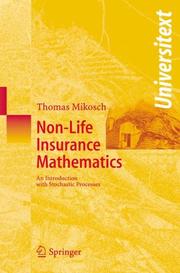
Non-life insurance mathematics
Thomas Mikosch · 2004
Where to buy
Amazon’s price changes daily, so the most accurate place to see it is there, at the moment you buy.
View on AmazonAbout the book
This book offers a mathematical introduction to non-life insurance and, at the same time, to a multitude of applied stochastic processes. It gives detailed discussions of the fundamental models for claim sizes, claim arrivals, the total claim amount, and their probabilistic properties. Throughout the book the language of stochastic processes is used for describing the dynamics of an insurance portfolio in claim size space and time. In addition to the standard actuarial notions, the reader learns about the basic models of modern non-life insurance mathematics: the Poisson, compound Poisson and renewal processes in collective risk theory and heterogeneity and Bühlmann models in experience rating. The reader gets to know how the underlying probabilistic structures allow one to determine premiums in a portfolio or in an individual policy. Special emphasis is given to the phenomena which are caused by large claims in these models. What makes this book special are more than 100 figures and tables illustrating and visualizing the theory. Every section ends with extensive exercises. They are an integral part of this course since they support the access to the theory. The book can serve either as a text for an undergraduate/graduate course on non-life insurance mathematics or applied stochastic processes. Its content is in agreement with the European "Groupe Consultatif" standards. An extensive bibliography, annotated by various comments sections with references to more advanced relevant literature, make the book broadly and easiliy accessible.
First sentence: In 1903 the Swedish actuary Filip Lundberg [55] laid the foundations of modern risk theory.
Book details
- Year
- 2004
- Language
- English
- Publisher
- Springer
- Editions
- 3
- Pages
- 246
- ISBN
- 9783540406501
Data source: Wikidata
More by Thomas Mikosch