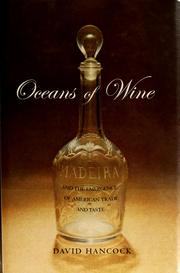
Oceans of wine
Hancock, David · 2009
Where to buy
Amazon’s price changes daily, so the most accurate place to see it is there, at the moment you buy.
View on AmazonAbout the book
"This innovative book examines how, between 1640 and 1815, the Portuguese Madeira wine trade shaped the Atlantic world and American society. David Hancock painstakingly reconstructs the lives of producers. distributors, and consumers, as well as the economic and social structures created by globalizing commerce, to reveal an intricate interplay between individuals and market forces. Ranging widely across history, economics, chemistry, material culture, anthropology, archaeology, and psychology, Hancock paints an engaging portrait of a commodity and the societies that grew up around it. Wine lovers and Madeira enthusiasts will enjoy Oceans of Wine, as will historians interested in food, colonial trade, and the history of the Atlantic region." "Using voluminous archives of records pertaining to wine, many of them previously unexamined, Hancock offers a dramatic new perspective on the economic and social development of the Atlantic world by challenging traditional interpretations that have identified states and empires as the driving force behind trade. He demonstrates convincingly just how decentralized the early modern commercial system was, as well as how self-organized, a system that emerged from the actions of market participants working across imperial lines. The networks they formed began as commercial structures, and expanded into social and political systems that were conduits not only for wine but also for ideas about reform, revolution, and independence. Oceans if Wine reframes American history as Atlantic history, placing colonial America and the early republic within an expansive, global context."--BOOK JACKET.
Book details
- Year
- 2009
- Language
- English
- Series
- The Lewis Walpole series in eighteenth-century culture and history
- Publisher
- Yale University Press
- Editions
- 2
- Pages
- 632
- ISBN
- 9780300136050
Data source: Wikidata