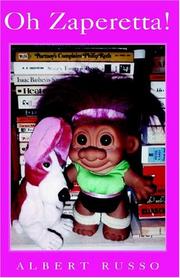
Oh Zaperetta!
Albert Russo · 2004
Where to buy
Amazon’s price changes daily, so the most accurate place to see it is there, at the moment you buy.
View on AmazonThis is an affiliate link: if you buy through it, the site earns a small commission at no extra cost to you, which helps us bring quality content and maintain the site. As an Amazon Associate we earn from qualifying purchases.
About the book
Review by David Alexander Zulu Zapy Wins the Rainbow Nation Authors who, like Shakespeare, make wisdom come out of the mouths of fools are nothing new. In addition to fools, juveniles, curmudgeons and ingenues have all been created by authors to speak truths that would otherwise be hard to take or impossible to fathom. The technique may be as old as literature itself, but the distinction of having done it exceedingly well has been won by only a few. Voltaire, in creating Candide, was among these select few writers. Mark Twain, in Huckleberry Finn was another. Dickens was a master of the art. Albert Russo is also a master of this art, and a modern master at that. His hand is sure and his store of bon mots, exiting with irreppresible verve from his continuing character Zapinette, seems inexhaustible, as does Zapinette's supply of malapropisms attuned to the trend-consciousness of 21st century global society. Indeed while the word malapropism refers to the Dickensian character Mrs. Malaprop, whose pronouncements were the direct opposite of apropos, I suggest that the new coinage of zapropisms should be used to denote the deliberate misuse of trendy, hip or globalist catchwords of this century, just as Ms. Malaprop made a cleverly ambiguous mockery of those of the 19th by her locutions, for Zapy is a veritable zapropotamus of zapropisms that help make the book a delight to read. (And I use the word "delight" advisedly, reflecting back along the turned tides of decades to the moment in a college class on the Romantic poets with British poet Elizabeth Sewell, who remarked when I stated that the purpose of literature was to entertain that, no, literature's purpose was to "delight, not entertain." Sewell used the word delight in the same sense 19th century critic Matthew Arnold used it. Steeped in Coleridge, Wordsworth, Shelley and the like, she'd had a very precise gamut of meaning for the word, as I do, here.) The novel's plot takes Zappinette, in the company of her usual foil, or straight-man, her Uncle Berky (variously called Unky Berky or Uncle Bonka), to visit family in South Africa, a trip resulting from a contest run by the French government, the fine print of whose terms required the travelers to act as unofficial ambassadors of goodwill on what, according to contest rules, is a "humanitarian" journey in which they'll have to complete "fieldwork" and report back to the French government. Here it should be noted that our 12-year-old heroine Zapy is a perso
Book details
- Year
- 2004
- Language
- English
- Publisher
- Xlibris Corporation
- Editions
- 2
- Pages
- 476
- ISBN
- 9781413470147
Data source: Wikidata
More by Albert Russo