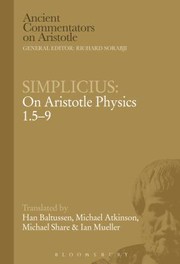
On Aristotle Physics 159
Han Baltussen · 2012
Where to buy
Check today’s price on Amazon. We do not show prices because they change daily.
View on AmazonAffiliate link. As an Amazon Associate we earn from qualifying purchases.
About the book
"Simplicius' greatest contribution in his commentary on Aristotle on Physics 1.5-9 lies in his treatment of matter. This is its first translation into English. The sixth-century philosopher starts with a valuable elucidation of what Aristotle means by 'principle' and 'element' in Physics. Simplicius' own conception of matter is of a quantity that is utterly diffuse because of its extreme distance from its source, the Neoplatonic One, and he tries to find this conception both in Plato's account of space and in a stray remark of Aristotle's. Finally, Simplicius rejects the Manichaean view that matter is evil and answers a Christian objection that to make matter imperishable is to put it on a level with God. This is the first translation of Simplicius' important work into English."--Bloomsbury Publishing Simplicius' greatest contribution in his commentary on Aristotle on Physics 1.5-9 lies in his treatment of matter. The sixth-century philosopher starts with a valuable elucidation of what Aristotle means by 'principle' and 'element' in Physics. Simplicius' own conception of matter is of a quantity that is utterly diffuse because of its extreme distance from its source, the Neoplatonic One, and he tries to find this conception both in Plato's account of space and in a stray remark of Aristotle's. Finally, Simplicius rejects the Manichaean view that matter is evil and answers a Christian objection that to make matter imperishable is to put it on a level with God. This is the first translation of Simplicius' important work into English.
Book details
- Year
- 2012
- Language
- English
- Publisher
- Bristol Classical Press
- Editions
- 1
- Pages
- 169
- ISBN
- 9780715638576
Data source: Wikidata
More by Han Baltussen